Showing posts with label Murray State. Show all posts

Wednesday, October 22, 2014

Mapping Nobel Prize Winning Women

After the recent passing of author Doris Lessing (1919-2013) I became curious how many women have received the Nobel Prize since 1901. Not that many I have come to discover. Of the 851 individual Laureates, 45 have been women, or roughly 5%. According to NobelPrize.org, 25 organizations have been awarded the Nobel Prize, as well. Examples of organizations include Bangladesh's Grameen Bank (2006), Medecins Sans Frontieres (Doctors Without Borders, 1999), Amnesty International (1977), and the United Nations Children's Fund (UNICEF, 1965).

The connection between education for women and girls and economic progress and development is clear. Investments in education for women and girls in developing and underdeveloped countries results in positive economic and social progress. Around the world, from the United States to Africa and Southwest Asia, investment in education, and especially STEM education, improves wages, improves health care, reduces child mortality, and increases political action and commitment.

My hopes are the map may help inspire people to improve the recognition of the contributions of women throughout all segments of global society. 


Click "Legend" to open the map's legend. The pins are color-coded by the Nobel award, green for chemistry, red for physics, silver for economics, and so forth. Click on a pin and the information for a particular Nobel winner will appear. When the window opens, scroll to the bottom. I added a link to the winner's entry on NobelPrize.org and used a link to their Wikipedia.org entry for a picture, if one was available. I assigned the colors, by the way. The interactive map above was created from a simple spreadsheet.

The spreadsheet is very simple to create. A little forethought must be given to how the data is organized. As I tell my students, you don't have to be an expert in the topic, but you do have to understand how to organize information. In this case, I mapped the winners by their place of birth. However, in many cases, the winners did not their award in their home country. Before and during World War Two, a mass exodus of people from Western, Central, and Eastern Europe occurred in advance of Nazi Germany influence. In some cases, the location does not note the place of birth but the country of residence at the time of the award. This special circumstance might make for an interesting lesson plan for middle or high school students, by the way. Both men and women Nobel Prize awards for the 1940's exhibited considerably disruption due to the war.


As the above spreadsheet illustrates, nothing fancy is going on. Year, Winner's Name, City, Country, Prize Category, etc. A couple of special notes; for the data to be mapped, some information about location must be provided. Now, I have provided "city" and "country." I could use a technique called "geocoding," but this process comes at a real cost. Some processes included with ArcGIS Online come with a real dollar amount attached and cost real money. Geocoding is one of those processes. I opted not to charge geocoding against our account and elected to use geographic coordinates instead. Thus, the "x" and "y" are latitude and longitude. The ArcGIS Online dashboard comes equipped to handle data attached to geographic coordinates at no cost to the user. The upload process is also smart enough to identify geographic coordinates in a spreadsheet in the event an unsophisticated user provided unusual field headings, like "peanut_butter" and "jelly." The data within the record is often enough to offset unfortunate headings.

There are two columns missing from the above graphic. The first missing field is "image_LNK." This is a reserved field name. Use this field to provide a link to an online image. The field must contain the fully qualified URL to the image. The second missing field is "wiki_LINK." This field contains the URL to pertinent Wikipedia page. I believe adding other custom fields is possible, though I have not explored this potential. To provide better coverage, below is the rest of the spreadsheet.


This is not a precise tutorial for putting data online. The process is not more involved than what I have described, though. ArcGIS Online maps can be shared with selected Murray State people or Murray State groups, or can even be made public. And, as you have see above, can even be embedded in a website.

The same potential for building map applications similar to the two maps I have posted exists for kids in kindergarten through high school in Kentucky. Sponsored by the Kentucky Geographic Alliance, all K-12 schools in Kentucky have at their disposal ArcGIS Online for Education. Check out connected.esri.com for complete details.

For more information about ESRI's ArcGIS Online for Education at Murray State contact Michael Busby at the Mid-America Remote sensing Center (MARC.)

Dr Robin Zhang Keeps Up with Geoscience Graduates

In the 2013-2014 academic year Murray State University charged individual departments with keeping track of graduates. Figuring out geographic distributions, mapping geography, is something geographers tend to be pretty good at. In the Department of Geosciences, Dr. Robin Zhang took on the task of mapping where Geosciences graduates end up soon after graduation.

Using ArcGIS Online, a free mapping application provided by ESRI courtesy of MSU/MARC, Dr. Zhang decided to give the mapping application a shot. Below, is the GIS-based mapping application created by Dr. Zhang illustrating the distribution of Geosciences graduates.


Interactive maps like the one above are pretty easy to create. To create one of these interactive maps, an ESRI Global Account is required. These accounts are free, created simply by visiting ESRI.com and filling out a short form. An account can also be created by the local ESRI Site License Administrator, Michael Busby. An invitation to join the Murray State University ArcGIS Online community is also necessary. Again, this request goes to the local ESRI Site License Administrator, or can be handled during the ESRI account request.

The account provides access to ESRI's ArcGIS Online for Education. The next bit of the puzzle is managing the data. In Dr. Zhang's map app, her data were the locations of Geosciences alumni - people. People will gainful employment are typically tied to an employer's address, a building. The building can be located in a number of ways, but most commonly with an address or a set of coordinates. By clicking on one of the colored dots, information on a person is revealed, including the longitude and latitude (x and y) of the employer's location. To put a point on a globe one needs a coordinate, a longitude and latitude. With that important element in a spreadsheet, each row in a spreadsheet then becomes a mappable record.

In essence, one really only needs a spreadsheet replete with information, tied in some way to a place on the Earth. Then, an interactive map is born. In my next post, I will demonstrate my interactive map and provide an example of my spreadsheet.


Wednesday, September 3, 2014

Archaeology Prints Its First Object

In early August, Dr. Kit Wesler was finally able to get his Cubify CubeX Duo up-and-running. Not through any fault of his own; several work orders were stacked up to bring electric and networking to his Terrain Modeling Laboratory. Once the CubeX Duo had a firmware update, a test file was uploaded to the printer. The CubeX Duo is only connected to computer to receive firmware updates. Print files (.STL) are moved to the 3D printer via a USB drive. The onboard computer and menu system provides access to printing specific print files. The short video below shows the printer in action.

The Cubify CubeX Duo was purchased along with a 3D scanner as part of a long-term project to generate models of archaeological artifacts. A collection of model archaeological artifacts would be assembled into interpretive collections for distribution to local primary and secondary schools to enhance students knowledge of local history and culture. These model artifacts would represent primarily the Mississippian culture which existed throughout much of the southeast United States from about 800 A.D. to approximately 1600 A.D. (New Georgia Encyclopedia)


So, what was printed? A rook, the test file provided by Cubify (above). The Murray State coaster and dime (on the coaster) provide scale. The print job took about 4 hours. The level of detail is pretty cool; not seen in the image is the spiral staircase running from the floor to roof inside the rook. Many of these 3D printers create very impressive levels of details even as seen from the outside. If one were to examine these objects closer, the interiors of most objects also contain high amounts fine details only visible by close scrutiny.

3D printing and scanning, outrageously expensive a mere 5 years ago, are becoming nearly commonplace. Such vendors as Cubify, Makerbot, and Printrbot provide entry level printers affordable to home enthusiasts. Some models are less than a $1000, putting them within reach of individuals, schools, and small businesses. 3D printing and scanning is rapidly becoming the basis of DIY, entrepreneurial fabrication, and a necessary tool for the Maker movement.

Sunday, June 29, 2014

2014-2015 Grant Proposals Now Being Accepted by MSU Office of Regional Outreach

Grant-funding opportunities can arise infrequently yet are important sources of funding for getting an important educational activity started. The Murray State University Office of Regional Outreach helps facilitate education grants and grant-funding.

Murray State University’s (MSU) Office of Regional Outreach has announced its 2014-15 grant funding cycle. Now in its seventh year, the Regional Outreach Grant Program provides seed money for new and innovative educational programming for West Kentucky youth and adults. Applications are accepted for review at any time during the fiscal year (June 1, 2014 through July 31, 2015) as long as funds are available.

Grants are competitive and funding is awarded on a first-come, first-serve basis until funds are depleted. Grant proposal must include a 1:1 match in funding or comparable in-kind support. 

For complete grant details, please visit www.murraystate.edu/outreach.

Examples of internal Murray State University grants funded include: Dr. Renee Fister (mathematics and statistics) and Dr. Dina Byers and Dr. Dana Manley (nursing) for their collaborative “Health in a Box” project; Dr. Pam Matlock and Greg Gierhart (education) for their “Math Out of a Bag” program; and Dr. Aleck Leedy (engineering) for “Mobile Engineering Days.”

Some projects in the greater Murray State service region have also received important funding. Examples include Junior Achievement of West Kentucky, West Kentucky Educational Cooperative for the Prescription Drug Awareness Symposium, the Associated General Contractors of West Kentucky for Construction Career Day, and the Pennyrile Resource and Development Council for their “Building Bridges to Success” series for school children at Jeffers Bend Environmental Center and Botanical Garden.

Complete story by Bentley Utgaard can be found at http://www.roundaboutmurray.com/?p=6627

Friday, June 13, 2014

Dr. Brandi King Presenting LEGO Robotics Workshop to Regional K-12 Educators.

From "Roundabout Murray" for June 12, 2014.

An upcoming opportunity to learn how to integrate LEGO® robotics in the classroom will provide K-12 teachers from Murray State University’s 18-county service region tools to diversify teaching strategies and address Kentucky Common Core STEM (science, technology, engineering and math) standards. The Office of Regional Outreach is partnering with Dr. Brandi King in the College of Education to present a free two-day LEGO® robotics education workshop for K-12 teachers in the region on June 26-27.

According to King, this training opportunity will “prepare teachers to work with students using LEGO® robotics kits. Participants will be expected to use the kits with students in the classroom, in an after-school club setting or coach a First LEGO® League team, which is for students ages 9-14.”

King’s passion for robotics prompted her to direct robotics summer camps for kids on Murray State’s campus and, more recently, to provide teachers with more hands-on instruction options. “The more teachers who have this technology at their fingertips, the more children who can be exposed to it in the classroom since not all kids can attend the camps,” King noted.

All participants will be loaned the use of one LEGO® robotics kit for one school year. Homeschool teachers are encouraged to sign up as well.

To register, contact King at bking11@murraystate.edu or call Regional Outreach at 270.809.5888

And if you have time, check out this LEGO video showcasing how LEGO robotics addresses Common Core Science Standards.

Thursday, June 12, 2014

Kickstart a Makerspace

Adapted from "Kickstart A Kid's Makerspace," by James Floyd Kelly; Make Magazine; Vol. 38; April/May 2014.

When I run across a good idea I occasionally take exception to parts of the idea's premise. Take this article by Mr. Kelly. He has an awesome idea. He states, "Young makers grow up to become world-changing engineers and leaders." I agree wholeheartedly. So, why would I take exception to his idea?

Because I don't think it should be limited exclusively to kids.

Many people have great ideas. Some people are late bloomers, and don't get an original idea until later in life, in their 40s, 50s, or 60s. Why should brilliant technology be provided exclusively to the young? Aren't we really interested in fostering ideas, regardless of age, gender, or race, or religion?

Blacktooth laser cutter
 The notion of placing technology in the hands of our youth makes complete sense. After all, we adults want to raise thoughtful adults to take care of us in our old age, after our days of making and creating have been replaced by sipping cool drinks on the beach reading our favorite yarn. But, like I said, placing tech and ideas in the hands of more than our youth seems like a good idea, especially those college-aged youth who never had an opportunity to be creative, and adults back-in-college who may want to be entrepreneurs and create jobs.

Kelly outlines a couple of paths to follow, a low-cost Makerspace valued at about $11,000; and a higher-cost Makerspace, valued at about $24,000.

CNC router
I don't want to re-create Kelly's great article here; we can all read and evaluate. We should all consider the long-term value in investing in such technologies from a variety of perspectives. Nothing bad, and much good can from these experiences.

If you don't read Make magazine, you should.

Also, check out makezine.com for thousands of ideas for making, creating, building, wiring, and programming.


Friday, June 6, 2014

Murray State University’s Summer Cyber Academy

The Summer Cyber Academy, a telecommunications technology camp for high school students, will begin its first session on June 8. The mission of Cyber Academy is to expose high school students to computer technologies through hands-on, interactive activities.

The camp is sponsored by the Murray State University’s Program of Distinction in Telecommunications Systems Management (TSM). It gives high school students the opportunity to learn about a variety of technologies while introducing them to the college atmosphere through residential housing, campus dining and other on-campus functions.

Each summer there are two levels of camp offered. The first-year camps are designed for students at any experience level. During first-year camps, students will learn everything from building networks to installing and configuring network applications while earning three hours of college credit at Murray State. The security camp (second-year) is aimed at returning campers and focuses on network and host security. Throughout the security camp, campers will learn network defense techniques, network traffic analysis, how to bridge firewalls and much more.

Students attending camp stay on Murray State’s campus for five days and are supervised by TSM student counselors as well as TSM staff. Although the majority of the time is spent in the lab, several other activities are planned for the students to enjoy during the week. These activities include movie nights, scavenger hunts around campus, and time at the Bauernfeind Student Recreation and Wellness Center.

The 2014 Cyber Academy dates are set for June 8-13 and June 22- 27 (first year), and the Security Academy on July 6-11. Visit the website for more information, the academy application, a promotional video, photos, staff information and other important details about Cyber Academy at www.murraystate.edu/tsm/cybercave. For questions, contact Annie Vandiver at the Center for Telecommunications Systems Management at 270.809.3987.

2014 Kentucky Girls STEM Collaborative Conference

The 2014 Kentucky Girls STEM Collaborative Conference Committee invites you and your female students to come take part in an extremely exciting and hands-on experience!

The "Health Sciences and Other Interesting Careers for Girls Conference" offers a plethora of educational ideas for educators and counselors, as well as several exciting activities for girls in grades 5 - 12 who are interested in the STEM fields.

Dress casually comfortable as Lesha Shumpert gets the day started off with Zumba exercise for everyone!

Pre-registration is required and lunch is included.

Adult registration can be completed on this page
For Student Registration, please visit this page.

Deadline: 6/9/2014. $30.00 (adults) (No charge for students - Lockheed Martin provided a generous donation covering student registration fees for the 2014 KGSC Conference).

Date: Friday, June 13, 2014 - 8:30am - 3:45pm
Where: Murray State University Crisp Center, 4430 Sunset Avenue, Paducah, KY 42001
Phone: (270)534-3111 or (800)669-7654
Fax: (270) 534-6292

Websites:
Kentucky Girls STEM Collaborative
National Girls Collaborative Project

Thursday, June 5, 2014

Murray State to Host Local "SharkTank"

Murray State University is hosting a SharkTank-type entrepreneurial pitch contest this month. The event is scheduled for Tuesday, June 17, 11:00 a.m., inside Heritage Hall. The competition is sponsored by the Office of Entrepreneurship within the Kentucky Cabinet for Economic Development, along with the Kentucky Angels Network and the Kentucky Innovation Network.

Loretta Daniel, Director of the Innovation and Commercialization Center (ICC) at Heritage Hall, said the competition is open to teams of three-to-four people with the winner in Murray taking home $1,000. The winning team will also advance to a competition this fall in Frankfort, where team members will pitch their idea directly to the entire Kentucky Angel Investors Network (Kentucky Angels).

The competition is open to the public, and will be a good way for local inventors to mingled, meet, and network.

Anyone wishing to enter the pitch competition should visit www.kyinnovation.com or contact Daniel at 270-809-6071.


Tuesday, May 27, 2014

Murray State Receives PICMatch Grant

The Department of Mathematics and Statistics, Jesse D. Jones College of Science, Engineering and Technology (JCSET), was recently awarded a Preparation for Industrial Careers in the Mathematical Sciences (PIC Math) grant by the Mathematical Association of America (MAA). PICMath is a program to prepare "mathematical sciences students for industrial careers by engaging them in research problems that come directly from industry." (MAA.org)

Dr. Renee Fister
"A strong component of PIC Math involves students working as a group on a semester-long undergraduate research problem from business, industry, or government." (MAA.org)

"PIC Math provides faculty with content for a semester-long, credit-bearing course focused on solving industrial problems. Each faculty participant will assemble a team of three to five students and work with them to develop their problem solving, teamwork, and communication skills. Each team will choose from one of five problems that are realistic yet suitable for undergraduate students." (MAA.org)

In preparation for administrating the grant, Dr. Renee Fister will travel to an orientation seminar in Salt Lake City, Utah in early June 2014.

The students will begin working within the PIC Math grant program Spring 2015.

Friday, May 16, 2014

Kristen Garcia: IEEE Student Featured on Murray State's Website


Kristin Garcia is an Engineering Physics major, Mathematics minor, from Milan, Tennessee. One of Kristin's major accomplishments was helping to reform Murray State's IEEE student chapter in 2011. Ms. Garcia is a junior at Murray State.

Monday, April 28, 2014

reddit's Alexis Ohanian Speak at 2014 Next Big Thing Conference

Alexis Ohanian and Rudy Ottway
On Monday, April 28th, Alexis Ohanian was the keynote speaker at the 2014 Next Big Thing Conference at Murray State University. Alexis Ohanian, graduate of UVA, is the co-founder of the social media website, reddit. Alexis was invited to address young people participating in the Next Big Thing Conference, an event inviting young entrepreneurs from western Kentucky to Murray State and allowing them the opportunity to present new and unique ideas and inventions. The event is sponsored by the Innovation and Commercialization Center (ICC) at Murray State University.

Alexis also has a new book out, detailing the efforts he and his co-founder, Steve Huffman, encountered while developing reddit. "Without Their Permission: The 21st Century Will Be Made, Not Managed" provides commentary and insights to people looking for advice and knowledge in working through their own start-up woes.

(Pictured is Alexis Ohanian and Murray State's Rudy Ottway, IET professor (JCSET))

Thursday, April 17, 2014

Rudy Ottway Receives 2014 Regents Excellence in Teaching Award

On April 17th, 2014, Professor Rudy Ottway, Industry and Engineering Technology (IET) was awarded the 2014 Regents Award for Teaching Excellence. 

Mr. Ottway instructs 3D printing, fabrication and design with the Jesse D. Jones College of Science, Engineering and Technology.

Videos of My. Ottway's 3D printing and design classes can be found on YouTube.

Tuesday, March 18, 2014

Joshua Hutson Conducts STLP Workshop

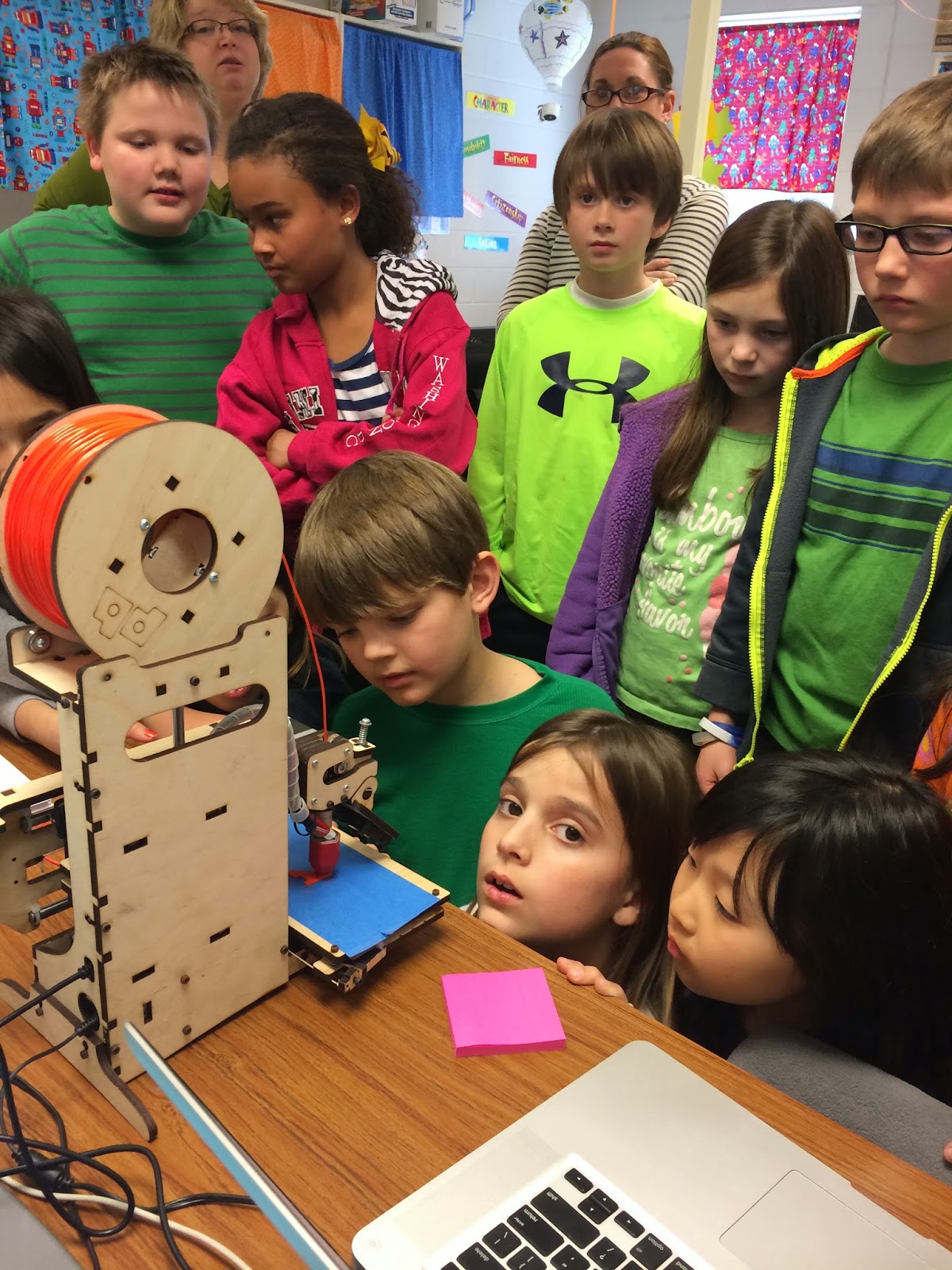
On March 17th, Joshua Hutson demonstrated his PrintrBot Simple as part of the Student Technology Leadership Program (STLP) at Murray Elementary School. Joshua also led the students through a Code.org programming tutorial.


The teacher-advisor for STLP informed Joshua there is a desire for more workshops like the one he has scheduled. The advisor also expressed interest in more projects similar to Joshua's and may need more Murray State faculty, staff, or students to present their efforts to STLP.

The Printrbot Simple is an affordable, entry-level 3D printer available from Printrbot. Printrbot Simple can be ordered as a kit or pre-assembled and includes only what is needed to get started in the world of 3D printing. (Source: printrbot.com/)

Code.org is a not-for-profit organization dedicated to expanding participation in computer science technology by women and students of color, but believes every student in every school should have the opportunity to learn computer programming. (Source: Code.org/about)

Update

"We had fun until the internet went down. Kandi Dawson the STLP teacher sponsor and parent volunteers were a great help." (J. Hutson)


Monday, March 10, 2014

Murray State IEEE Chapter Heads to IEEE SoutheastCon 2014

March 14th - March 15th, 2014 brings the annual SoutheastCon. Held at the University of Kentucky, the IEEE SoutheastCon brings together IEEE teams from around the Commonwealth to participate in a hardware-based competition, i.e. build a robot to accomplish some goal.

This year's Student Hardware Competition brings a challenge very appropriate for both Kentucky and the time of year. The 2014 challenge involves designing a robot to shoot a projectile from various distances to emulate the playing and shooting dynamics of basketball.

What better challenge than one aligned with basketball, SEC tournament play, and NCAA March Madness?

The objective will to build a a robot that operates on a simulated basketball court. The robot must follow three lines with randomly positioned shooting blocks and then fire a dart while positioned on top of the shooting block. Winners will be decided by number of points earned by completing goals and completion time so the highest scoring robots will be both fast and precise.

Friday and Saturday, teams will assemble and test their robots. Saturday afternoon, teams will compete, culminating in the awards ceremony Saturday night. Throughout each day, other activities are available, ranging from leadership training workshops, workshops on renewable energy, and RaspberryPi tutorials.

Wednesday, March 5, 2014

3D Printing Comes In Handy On Valentine's Day


Two Murray State Engineering Graphics and Design majors, Brooke Jones and Gavin Suver, designed and created custom Murray State-themed chocolate molds for Valentine's Day. Rudy Ottway, IET faculty, supervised their efforts.

Friday, February 28, 2014

Joshua Hutson Applies to Teach Arduino in Hart Hall

Joshua Hutson recently submitted an application to teach programming technologies in a section of IDC099. If approved, Joshua will be introducing Murray State students to Arduino via instruction and lab activities in Hart College. The IDC099 course will be available the 2nd-half of the Fall 2014 semester.

Tuesday, February 25, 2014

Murray State IET Hosts E-Day

Over 400 4th and 5th graders from around western Kentucky descended upon Murray State to experience physics. Faculty and students of the Jesse D. Jones College of Science, Engineering and Technology ran local middle school students through a variety of exercises, experiments, and technologies. 

The variety of stations allowed students hands-on access to simple robots, lighting & controller systems, human-sized Jenga blocks, and an egg-catapult. Each of these stations demonstrated simple and accessible technologies while also presenting the physics at work.