Murray State University is hosting a SharkTank-type entrepreneurial pitch contest this month. The event is scheduled for Tuesday, June 17, 11:00 a.m., inside Heritage Hall. The competition is sponsored by the Office of Entrepreneurship within the Kentucky Cabinet for Economic Development, along with the Kentucky Angels Network and the Kentucky Innovation Network.
Loretta Daniel, Director of the Innovation and Commercialization Center (ICC) at Heritage Hall, said the competition is open to teams of three-to-four people with the winner in Murray taking home $1,000. The winning team will also advance to a competition this fall in Frankfort, where team members will pitch their idea directly to the entire Kentucky Angel Investors Network (Kentucky Angels).
The competition is open to the public, and will be a good way for local inventors to mingled, meet, and network.
Anyone wishing to enter the pitch competition should visit www.kyinnovation.com or contact Daniel at 270-809-6071.
A STEM-based collaborative community of educators and students to promote science, design, and 21st century technologies at Murray State University, the local community, and the service region, to communicate and share stories, to provide resources, to enhance current learning environments, and engage curious minds from all walks of life.
Showing posts with label Design. Show all posts
Thursday, June 5, 2014
Wednesday, June 4, 2014
Capturing Bugs and Measuring Nitrogen with Arduino and RaspberryPi
Professor James Hardin's (JCSET) research interests lie at the "intersection of sensors and engineering design." (Personal website) In pursuit of those interests, James is working on a couple projects integrating his research interests with biology and the natural environment.
One project (left) is a simple nitrogen sensor. Using an optical contact sensor and some Arduino hardware, James and an undergraduate student created a nitrogen sensor for measuring nitrogen within a leaf. Merely lay the leaf atop the sensor (the small, white cylinder), and the microcomputer will measure and report the nitrogen bound within the leaf.
The second project is far more complicated. A field biologist needs to conduct an insect inventory of a test site. Perhaps the field biologist is looking for a collection of diagnostic insects, or perhaps, is looking for a certain insect.
Today, a field biologist would have to spend days upon days in the field, setting traps, shaking bushes, etc., and hope to collect some good samples.
What if ... what if the biologist could set a number of automated traps? These traps would collect an insect, trap the insect long enough to snap a pic, and release the insect back into the wild. The insect snapshot would be processed digitally, a form of facial recognition image processing technique applied, and the insect species would be identified and the pic classified. The pic and info would be transmitted via MMS/SMS to the biologist comfortably sitting in a field office or lab.
Dr. Hardin is working on a prototype of this insect trap. As shown (left), the white PVC Y-joint serves as the basis for mounting trap components. A RaspberryPi controller operates the mechanism for trapping the insect long enough to capture an image. Attached to the trap is an Android phone (right), the brains of the device.
The phone captures the image, processes and classifies the image, and provides a means to geolocate the insect. Once processed, the data is sent via MMS/SMS to the biologist, wherever that person might be stationed.
Dr. Hardin research demonstrates the utility in drawing the disciplines of engineering, biology, and geography together in the analysis of the a biological problem. His device captures an insect, performs non-invasive testing and initial interpretation, the results of which are transmitted back to a researcher who can integrate the data into a geographic database for spatial analysis.
Dr. James Hardin can be reached at jhardin@murraystate.edu (MSU/JCSET).
Thursday, April 17, 2014
Rudy Ottway Receives 2014 Regents Excellence in Teaching Award
On April 17th, 2014, Professor Rudy Ottway, Industry and Engineering Technology (IET) was awarded the 2014 Regents Award for Teaching Excellence.
Mr. Ottway instructs 3D printing, fabrication and design with the Jesse D. Jones College of Science, Engineering and Technology.
Videos of My. Ottway's 3D printing and design classes can be found on YouTube.
Mr. Ottway instructs 3D printing, fabrication and design with the Jesse D. Jones College of Science, Engineering and Technology.
Videos of My. Ottway's 3D printing and design classes can be found on YouTube.
Tuesday, March 18, 2014
Joshua Hutson Conducts STLP Workshop
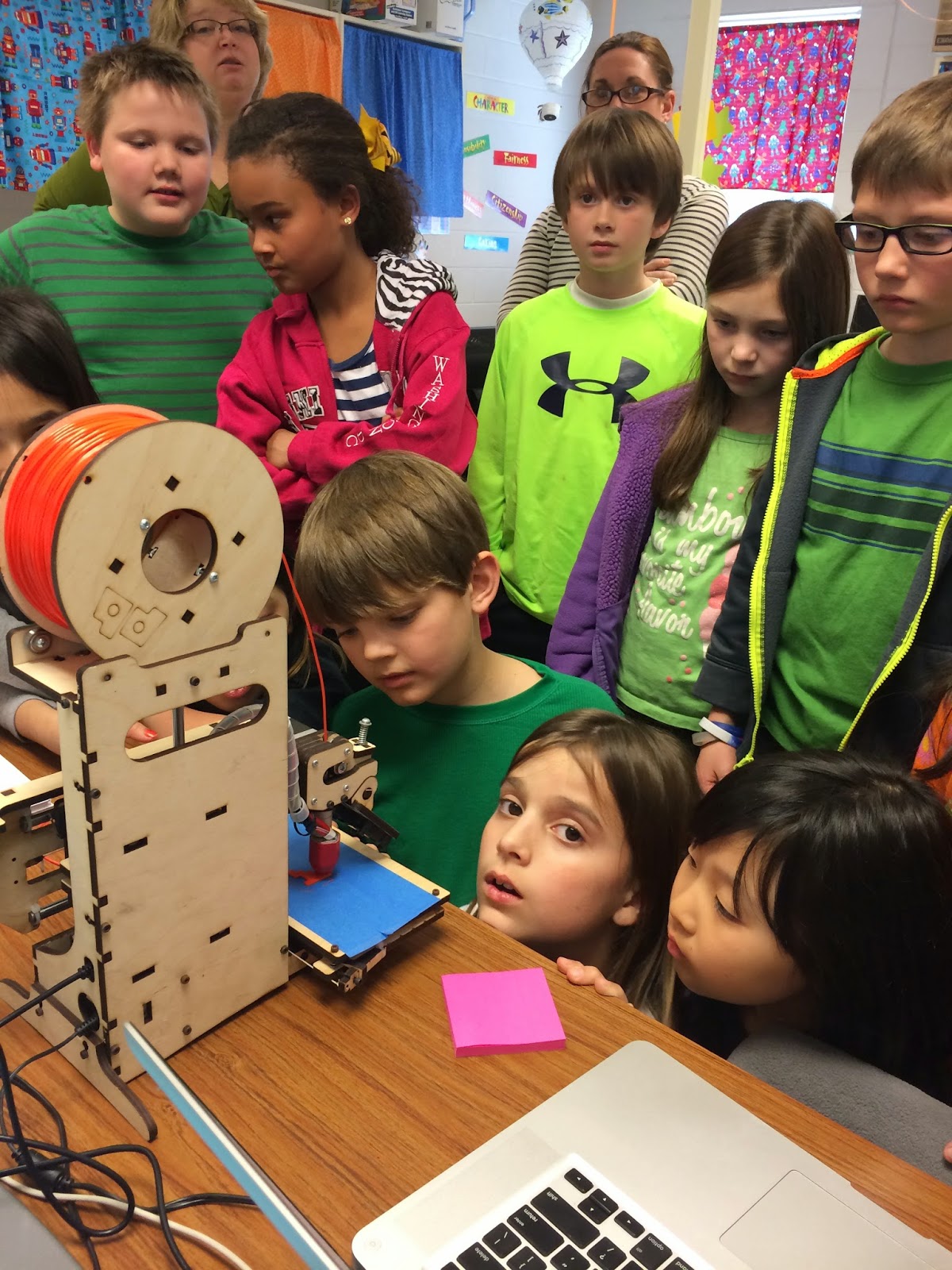
On March 17th, Joshua Hutson demonstrated his PrintrBot Simple as part of the Student Technology Leadership Program (STLP) at Murray Elementary School. Joshua also led the students through a Code.org programming tutorial.
The Printrbot Simple is an affordable, entry-level 3D printer available from Printrbot. Printrbot Simple can be ordered as a kit or pre-assembled and includes only what is needed to get started in the world of 3D printing. (Source: printrbot.com/)

The teacher-advisor for STLP informed Joshua there is a desire for more workshops like the one he has scheduled. The advisor also expressed interest in more projects similar to Joshua's and may need more Murray State faculty, staff, or students to present their efforts to STLP.
Code.org is a not-for-profit organization dedicated to expanding participation in computer science technology by women and students of color, but believes every student in every school should have the opportunity to learn computer programming. (Source: Code.org/about)
Update
"We had fun until the internet went down. Kandi Dawson the STLP teacher sponsor and parent volunteers were a great help." (J. Hutson)

Wednesday, March 5, 2014
3D Printing Comes In Handy On Valentine's Day
Two Murray State Engineering Graphics and Design majors, Brooke Jones and Gavin Suver, designed and created custom Murray State-themed chocolate molds for Valentine's Day. Rudy Ottway, IET faculty, supervised their efforts.
Subscribe to:
Posts (Atom)