Showing posts with label K12. Show all posts

Wednesday, October 22, 2014

GitHub Student Developer Pack

GitHub recently released a suite of software, programming resources, cloud development tools, and other development resources specifically for students.

The Education branch of GitHub has partnered with several providers to offer students a nice bundle of free services, software, and opportunities to begin app and service development.

For complete information, click here.

To be eligible, you must be a student aged 13+ and enrolled in a degree or diploma granting course of study. All one needs is a school-issued email address, valid student identification card, or other official proof of enrollment.

To get access to the pack, GitHub will need to verify your student status. Sign up using the form and GitHub will send you an email once you've been verified.

GitHub Education is also a great STEM resource for crowdsourcing programming, for software development, for learning to code, for improving code, and for all sorts of activities related to software development.


Wednesday, September 3, 2014

Archaeology Prints Its First Object

In early August, Dr. Kit Wesler was finally able to get his Cubify CubeX Duo up-and-running. Not through any fault of his own; several work orders were stacked up to bring electric and networking to his Terrain Modeling Laboratory. Once the CubeX Duo had a firmware update, a test file was uploaded to the printer. The CubeX Duo is only connected to computer to receive firmware updates. Print files (.STL) are moved to the 3D printer via a USB drive. The onboard computer and menu system provides access to printing specific print files. The short video below shows the printer in action.

The Cubify CubeX Duo was purchased along with a 3D scanner as part of a long-term project to generate models of archaeological artifacts. A collection of model archaeological artifacts would be assembled into interpretive collections for distribution to local primary and secondary schools to enhance students knowledge of local history and culture. These model artifacts would represent primarily the Mississippian culture which existed throughout much of the southeast United States from about 800 A.D. to approximately 1600 A.D. (New Georgia Encyclopedia)


So, what was printed? A rook, the test file provided by Cubify (above). The Murray State coaster and dime (on the coaster) provide scale. The print job took about 4 hours. The level of detail is pretty cool; not seen in the image is the spiral staircase running from the floor to roof inside the rook. Many of these 3D printers create very impressive levels of details even as seen from the outside. If one were to examine these objects closer, the interiors of most objects also contain high amounts fine details only visible by close scrutiny.

3D printing and scanning, outrageously expensive a mere 5 years ago, are becoming nearly commonplace. Such vendors as Cubify, Makerbot, and Printrbot provide entry level printers affordable to home enthusiasts. Some models are less than a $1000, putting them within reach of individuals, schools, and small businesses. 3D printing and scanning is rapidly becoming the basis of DIY, entrepreneurial fabrication, and a necessary tool for the Maker movement.

Tuesday, July 1, 2014

Autodesk for Students and Educators

Many software companies provide software solutions for colleges and universities. Having some experience with these licenses I can say some companies "don't get it," charging hundreds of dollars to students for trial versions of software which expire after a year. Autodesk, by comparison, does get it.

3D printing and design, 3D scanning technology, and other DIY fabrication devices require software to generate the files used in fabrication. Colleges and universities, after spending money to acquire fabrication technology are often strapped for cash to obtain necessary software. Often, the software arriving with the technology is good, but not "industry-standard." Faculty want to expose students to current software provided by industry leaders.

Years ago, software companies might provided "low-cost" versions of their software to students for educational use. While "enterprise" licenses might cost tens of thousands of dollar "per seat" (per computer), a student license might run $500-$1,000. Students would scoff at such offering despite the 90% discount from list. Software companies, at the time, didn't really understand that if they simply gave their software to schools to use in teaching, the students would want to use the software after gaining the experience, resulting in a built-in user base.

Most companies are catching on to the idea of using colleges and universities to develop a ready-made user base and are literally giving away software, or are engaging in very generous licensing agreements which reduce the cost of yearly licensing to pennies per seat. Kudos to those companies, by the way.


Autodesk has such an offer to colleges and universities. Autodesk offers colleges and universities the chance to enroll in their Educational Community program. Once enrolled, nearly all of Autodesk'
s software is available to the entire campus community.

Just a sample of Autodesk's Educational Community offering

The Autodesk Educational Community allows disciplines across campus to offer instructional software, teach design and encourage creativity. Autodesk is not paying me for writing this post; over time I have used 3Ds Max, AutoCad, AutoCad Map, SketchBook Express. I know people who use Maya as often as I use my wok (a lot).

If your campus is into design, creativity, fabrication, then see if you already are part of the Educational Community. If not, make some noise and see if you can get your institution signed-up for this great offering by an industry leader in graphic arts and design.

Friday, June 6, 2014

Murray State University’s Summer Cyber Academy

The Summer Cyber Academy, a telecommunications technology camp for high school students, will begin its first session on June 8. The mission of Cyber Academy is to expose high school students to computer technologies through hands-on, interactive activities.

The camp is sponsored by the Murray State University’s Program of Distinction in Telecommunications Systems Management (TSM). It gives high school students the opportunity to learn about a variety of technologies while introducing them to the college atmosphere through residential housing, campus dining and other on-campus functions.

Each summer there are two levels of camp offered. The first-year camps are designed for students at any experience level. During first-year camps, students will learn everything from building networks to installing and configuring network applications while earning three hours of college credit at Murray State. The security camp (second-year) is aimed at returning campers and focuses on network and host security. Throughout the security camp, campers will learn network defense techniques, network traffic analysis, how to bridge firewalls and much more.

Students attending camp stay on Murray State’s campus for five days and are supervised by TSM student counselors as well as TSM staff. Although the majority of the time is spent in the lab, several other activities are planned for the students to enjoy during the week. These activities include movie nights, scavenger hunts around campus, and time at the Bauernfeind Student Recreation and Wellness Center.

The 2014 Cyber Academy dates are set for June 8-13 and June 22- 27 (first year), and the Security Academy on July 6-11. Visit the website for more information, the academy application, a promotional video, photos, staff information and other important details about Cyber Academy at www.murraystate.edu/tsm/cybercave. For questions, contact Annie Vandiver at the Center for Telecommunications Systems Management at 270.809.3987.

2014 Kentucky Girls STEM Collaborative Conference

The 2014 Kentucky Girls STEM Collaborative Conference Committee invites you and your female students to come take part in an extremely exciting and hands-on experience!

The "Health Sciences and Other Interesting Careers for Girls Conference" offers a plethora of educational ideas for educators and counselors, as well as several exciting activities for girls in grades 5 - 12 who are interested in the STEM fields.

Dress casually comfortable as Lesha Shumpert gets the day started off with Zumba exercise for everyone!

Pre-registration is required and lunch is included.

Adult registration can be completed on this page
For Student Registration, please visit this page.

Deadline: 6/9/2014. $30.00 (adults) (No charge for students - Lockheed Martin provided a generous donation covering student registration fees for the 2014 KGSC Conference).

Date: Friday, June 13, 2014 - 8:30am - 3:45pm
Where: Murray State University Crisp Center, 4430 Sunset Avenue, Paducah, KY 42001
Phone: (270)534-3111 or (800)669-7654
Fax: (270) 534-6292

Websites:
Kentucky Girls STEM Collaborative
National Girls Collaborative Project

Tuesday, May 27, 2014

President Obama Hosts White House Science Fair

Today, President Obama hosted the White House Science Fair, bringing students from all across the country to demonstrate a wide variety of science interests and knowledge in our national schools.

Team Rocket (All-girl) from Maryland
Innovative students representing 30 states will display their ideas and inventions for the President and the wider viewing public. If you'd like a complete list of presenters, here you go.

President Obama also released significant details outlining several new education initiatives today. Not all of them will be presented here, and I will refer readers to the full White House press release.

The initiatives present continued funding, enhanced funding, or new plans to augment science, technology, engineering, and mathematics (STEM) education. Some of the new STEM goals include:
  • STEM Teacher Quality Partnership (TQP) grants.
  • Nationwide effort to engage Hispanic youth in STEM.
  • Global initiative to connect STEM students from around the world.
  • Expansion of STEM-based AmeriCorps.
  • Partnership with NASA and Khan Academy to provide free, online STEM education.
  • ESRI to provide ArcGIS Online for Education accounts to every K-12 school in the United States.
The President has also issued a "Call To Action" to all existing business partners, including Time/Warner, the Association of Science-Technology Centers (ASTC), and the newly established White House Maker Corps.

For more details, please check the White House press release here.

Tuesday, March 18, 2014

Joshua Hutson Conducts STLP Workshop

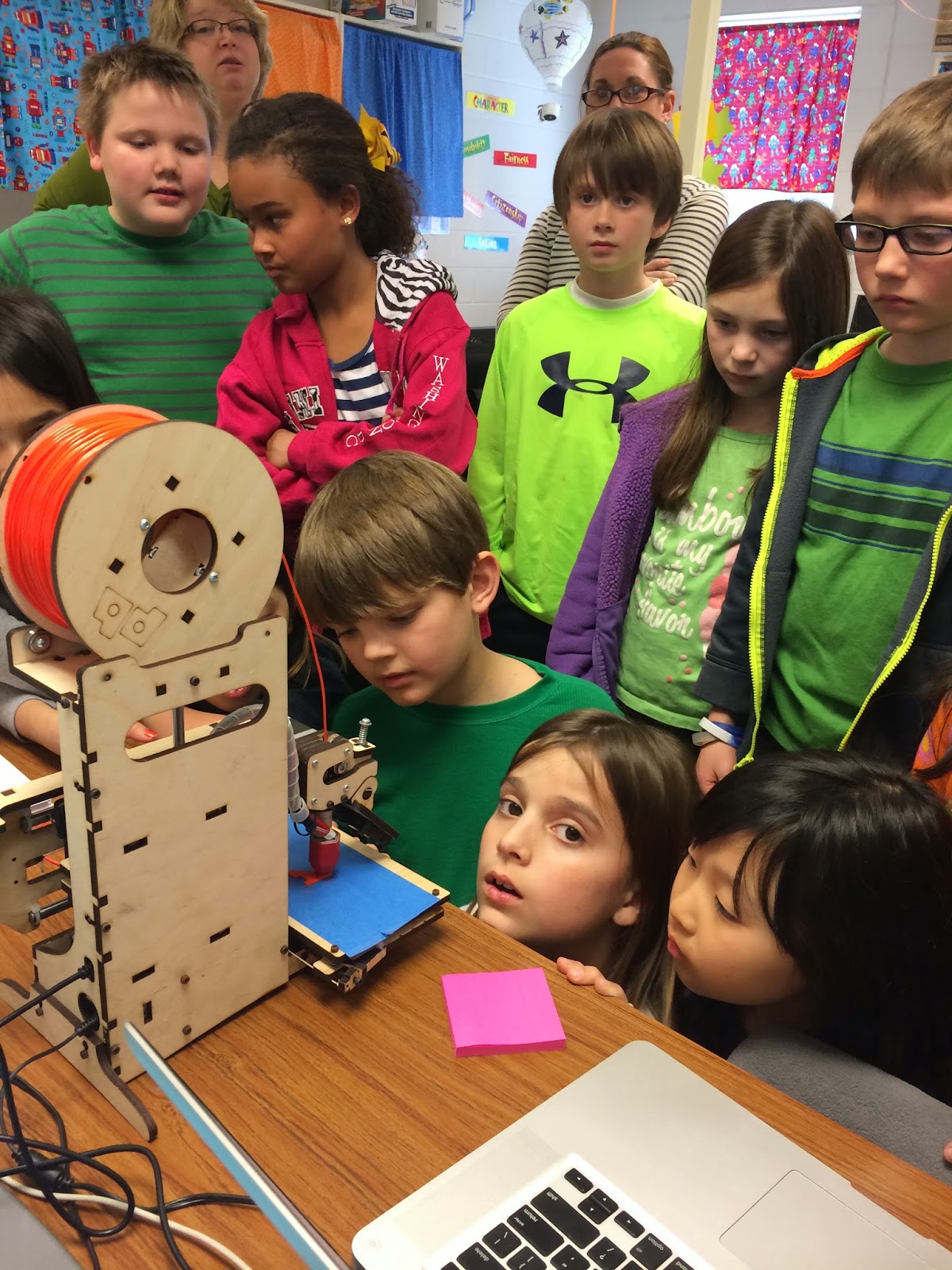
On March 17th, Joshua Hutson demonstrated his PrintrBot Simple as part of the Student Technology Leadership Program (STLP) at Murray Elementary School. Joshua also led the students through a Code.org programming tutorial.


The teacher-advisor for STLP informed Joshua there is a desire for more workshops like the one he has scheduled. The advisor also expressed interest in more projects similar to Joshua's and may need more Murray State faculty, staff, or students to present their efforts to STLP.

The Printrbot Simple is an affordable, entry-level 3D printer available from Printrbot. Printrbot Simple can be ordered as a kit or pre-assembled and includes only what is needed to get started in the world of 3D printing. (Source: printrbot.com/)

Code.org is a not-for-profit organization dedicated to expanding participation in computer science technology by women and students of color, but believes every student in every school should have the opportunity to learn computer programming. (Source: Code.org/about)

Update

"We had fun until the internet went down. Kandi Dawson the STLP teacher sponsor and parent volunteers were a great help." (J. Hutson)


Tuesday, February 25, 2014

Murray State IET Hosts E-Day

Over 400 4th and 5th graders from around western Kentucky descended upon Murray State to experience physics. Faculty and students of the Jesse D. Jones College of Science, Engineering and Technology ran local middle school students through a variety of exercises, experiments, and technologies. 

The variety of stations allowed students hands-on access to simple robots, lighting & controller systems, human-sized Jenga blocks, and an egg-catapult. Each of these stations demonstrated simple and accessible technologies while also presenting the physics at work.