Showing posts with label 3D Printing. Show all posts

Wednesday, September 3, 2014

Archaeology Prints Its First Object

In early August, Dr. Kit Wesler was finally able to get his Cubify CubeX Duo up-and-running. Not through any fault of his own; several work orders were stacked up to bring electric and networking to his Terrain Modeling Laboratory. Once the CubeX Duo had a firmware update, a test file was uploaded to the printer. The CubeX Duo is only connected to computer to receive firmware updates. Print files (.STL) are moved to the 3D printer via a USB drive. The onboard computer and menu system provides access to printing specific print files. The short video below shows the printer in action.

The Cubify CubeX Duo was purchased along with a 3D scanner as part of a long-term project to generate models of archaeological artifacts. A collection of model archaeological artifacts would be assembled into interpretive collections for distribution to local primary and secondary schools to enhance students knowledge of local history and culture. These model artifacts would represent primarily the Mississippian culture which existed throughout much of the southeast United States from about 800 A.D. to approximately 1600 A.D. (New Georgia Encyclopedia)


So, what was printed? A rook, the test file provided by Cubify (above). The Murray State coaster and dime (on the coaster) provide scale. The print job took about 4 hours. The level of detail is pretty cool; not seen in the image is the spiral staircase running from the floor to roof inside the rook. Many of these 3D printers create very impressive levels of details even as seen from the outside. If one were to examine these objects closer, the interiors of most objects also contain high amounts fine details only visible by close scrutiny.

3D printing and scanning, outrageously expensive a mere 5 years ago, are becoming nearly commonplace. Such vendors as Cubify, Makerbot, and Printrbot provide entry level printers affordable to home enthusiasts. Some models are less than a $1000, putting them within reach of individuals, schools, and small businesses. 3D printing and scanning is rapidly becoming the basis of DIY, entrepreneurial fabrication, and a necessary tool for the Maker movement.

Tuesday, July 1, 2014

Autodesk for Students and Educators

Many software companies provide software solutions for colleges and universities. Having some experience with these licenses I can say some companies "don't get it," charging hundreds of dollars to students for trial versions of software which expire after a year. Autodesk, by comparison, does get it.

3D printing and design, 3D scanning technology, and other DIY fabrication devices require software to generate the files used in fabrication. Colleges and universities, after spending money to acquire fabrication technology are often strapped for cash to obtain necessary software. Often, the software arriving with the technology is good, but not "industry-standard." Faculty want to expose students to current software provided by industry leaders.

Years ago, software companies might provided "low-cost" versions of their software to students for educational use. While "enterprise" licenses might cost tens of thousands of dollar "per seat" (per computer), a student license might run $500-$1,000. Students would scoff at such offering despite the 90% discount from list. Software companies, at the time, didn't really understand that if they simply gave their software to schools to use in teaching, the students would want to use the software after gaining the experience, resulting in a built-in user base.

Most companies are catching on to the idea of using colleges and universities to develop a ready-made user base and are literally giving away software, or are engaging in very generous licensing agreements which reduce the cost of yearly licensing to pennies per seat. Kudos to those companies, by the way.


Autodesk has such an offer to colleges and universities. Autodesk offers colleges and universities the chance to enroll in their Educational Community program. Once enrolled, nearly all of Autodesk'
s software is available to the entire campus community.

Just a sample of Autodesk's Educational Community offering

The Autodesk Educational Community allows disciplines across campus to offer instructional software, teach design and encourage creativity. Autodesk is not paying me for writing this post; over time I have used 3Ds Max, AutoCad, AutoCad Map, SketchBook Express. I know people who use Maya as often as I use my wok (a lot).

If your campus is into design, creativity, fabrication, then see if you already are part of the Educational Community. If not, make some noise and see if you can get your institution signed-up for this great offering by an industry leader in graphic arts and design.

Wednesday, June 25, 2014

Nation of Makers

"I am proud to host the first-ever White House Maker Faire. This event celebrates every maker — from students learning STEM skills to entrepreneurs launching new businesses to innovators powering the renaissance in American manufacturing. I am calling on people across the country to join us in sparking creativity and encouraging invention in their communities." President Obama on June 17, 2014
The Maker Movement has gained its most prominent supporter, President Barack Obama. On June 17th, 2014, the White House hosted the first (and I am hoping annual) Maker Faire. From this day forward, June 18th will be known nationally as the "National Day of Making." You can read his proclamation here.

Hundreds of people participated in the White House Maker Faire. David Perry played his 3D printed violin at the White House, Russell the Electric Giraffe made his debut, and 17-year old Darius demonstrated his hand-built 3D printer. Check out the White House Maker Faire website for more details, videos, and a cameo by Bill Nye!


ESRI, the world's leading provider of geographic information systems software, provided a storymap helping illustrate the distribution of participants and provide some background information.

The White House has assumed an important role to help promote innovation and entrepreneurship through the Maker community. Users of Facebook can stay informed by following both Make and Maker Faire Facebook pages. User of Twitter can follow the #NationofMakers hashtag.

In a future post, I'll cover some methods of funding a Maker community, organizing a local Maker Faire, and share some anecdotes of my own experiences.

Thursday, June 12, 2014

Kickstart a Makerspace

Adapted from "Kickstart A Kid's Makerspace," by James Floyd Kelly; Make Magazine; Vol. 38; April/May 2014.

When I run across a good idea I occasionally take exception to parts of the idea's premise. Take this article by Mr. Kelly. He has an awesome idea. He states, "Young makers grow up to become world-changing engineers and leaders." I agree wholeheartedly. So, why would I take exception to his idea?

Because I don't think it should be limited exclusively to kids.

Many people have great ideas. Some people are late bloomers, and don't get an original idea until later in life, in their 40s, 50s, or 60s. Why should brilliant technology be provided exclusively to the young? Aren't we really interested in fostering ideas, regardless of age, gender, or race, or religion?

Blacktooth laser cutter
 The notion of placing technology in the hands of our youth makes complete sense. After all, we adults want to raise thoughtful adults to take care of us in our old age, after our days of making and creating have been replaced by sipping cool drinks on the beach reading our favorite yarn. But, like I said, placing tech and ideas in the hands of more than our youth seems like a good idea, especially those college-aged youth who never had an opportunity to be creative, and adults back-in-college who may want to be entrepreneurs and create jobs.

Kelly outlines a couple of paths to follow, a low-cost Makerspace valued at about $11,000; and a higher-cost Makerspace, valued at about $24,000.

CNC router
I don't want to re-create Kelly's great article here; we can all read and evaluate. We should all consider the long-term value in investing in such technologies from a variety of perspectives. Nothing bad, and much good can from these experiences.

If you don't read Make magazine, you should.

Also, check out makezine.com for thousands of ideas for making, creating, building, wiring, and programming.


Wednesday, June 4, 2014

Capturing Bugs and Measuring Nitrogen with Arduino and RaspberryPi


Professor James Hardin's (JCSET) research interests lie at the "intersection of sensors and engineering design." (Personal website) In pursuit of those interests, James is working on a couple projects integrating his research interests with biology and the natural environment.

One project (left) is a simple nitrogen sensor. Using an optical contact sensor and some Arduino hardware, James and an undergraduate student created a nitrogen sensor for measuring nitrogen within a leaf. Merely lay the leaf atop the sensor (the small, white cylinder), and the microcomputer will measure and report the nitrogen bound within the leaf.

The second project is far more complicated. A field biologist needs to conduct an insect inventory of a test site. Perhaps the field biologist is looking for a collection of diagnostic insects, or perhaps, is looking for a certain insect.

Today, a field biologist would have to spend days upon days in the field, setting traps, shaking bushes, etc., and hope to collect some good samples.

What if ... what if the biologist could set a number of automated traps? These traps would collect an insect, trap the insect long enough to snap a pic, and release the insect back into the wild. The insect snapshot would be processed digitally, a form of facial recognition image processing technique applied, and the insect species would be identified and the pic classified. The pic and info would be transmitted via MMS/SMS to the biologist comfortably sitting in a field office or lab.


Dr. Hardin is working on a prototype of this insect trap. As shown (left), the white PVC Y-joint serves as the basis for mounting trap components. A RaspberryPi controller operates the mechanism for trapping the insect long enough to capture an image. Attached to the trap is an Android phone (right), the brains of the device.

The phone captures the image, processes and classifies the image, and provides a means to geolocate the insect. Once processed, the data is sent via MMS/SMS to the biologist, wherever that person might be stationed.

Dr. Hardin research demonstrates the utility in drawing the disciplines of engineering, biology, and geography together in the analysis of the a biological problem. His device captures an insect, performs non-invasive testing and initial interpretation, the results of which are transmitted back to a researcher who can integrate the data into a geographic database for spatial analysis.

Dr. James Hardin can be reached at jhardin@murraystate.edu (MSU/JCSET).


Thursday, April 17, 2014

Rudy Ottway Receives 2014 Regents Excellence in Teaching Award

On April 17th, 2014, Professor Rudy Ottway, Industry and Engineering Technology (IET) was awarded the 2014 Regents Award for Teaching Excellence. 

Mr. Ottway instructs 3D printing, fabrication and design with the Jesse D. Jones College of Science, Engineering and Technology.

Videos of My. Ottway's 3D printing and design classes can be found on YouTube.

Tuesday, March 18, 2014

Joshua Hutson Conducts STLP Workshop

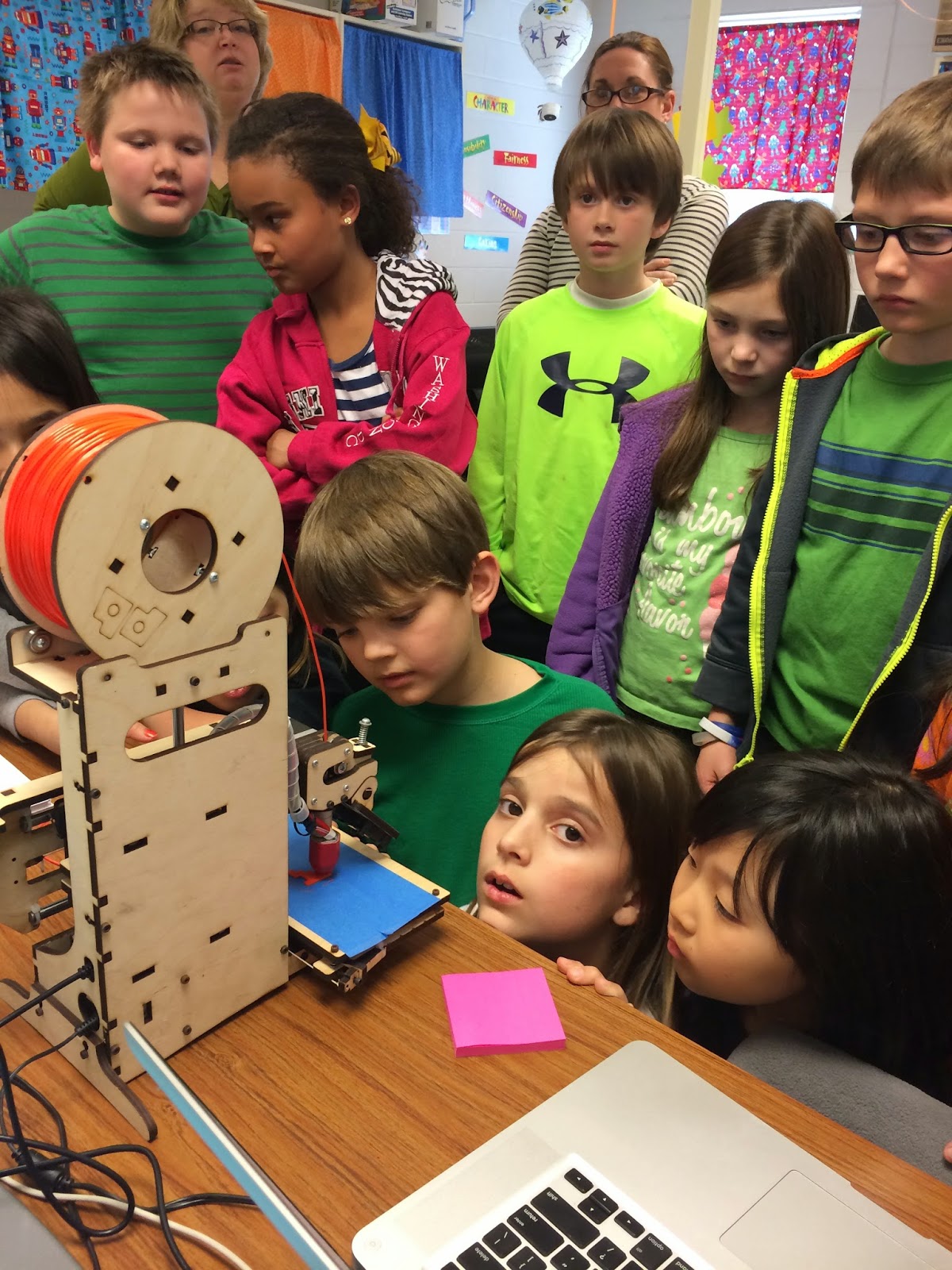
On March 17th, Joshua Hutson demonstrated his PrintrBot Simple as part of the Student Technology Leadership Program (STLP) at Murray Elementary School. Joshua also led the students through a Code.org programming tutorial.


The teacher-advisor for STLP informed Joshua there is a desire for more workshops like the one he has scheduled. The advisor also expressed interest in more projects similar to Joshua's and may need more Murray State faculty, staff, or students to present their efforts to STLP.

The Printrbot Simple is an affordable, entry-level 3D printer available from Printrbot. Printrbot Simple can be ordered as a kit or pre-assembled and includes only what is needed to get started in the world of 3D printing. (Source: printrbot.com/)

Code.org is a not-for-profit organization dedicated to expanding participation in computer science technology by women and students of color, but believes every student in every school should have the opportunity to learn computer programming. (Source: Code.org/about)

Update

"We had fun until the internet went down. Kandi Dawson the STLP teacher sponsor and parent volunteers were a great help." (J. Hutson)


Wednesday, March 5, 2014

3D Printing Comes In Handy On Valentine's Day


Two Murray State Engineering Graphics and Design majors, Brooke Jones and Gavin Suver, designed and created custom Murray State-themed chocolate molds for Valentine's Day. Rudy Ottway, IET faculty, supervised their efforts.